The Latin Quarter

St. Michael's Square
  • St. Michael's Square

  • Today, we're going to discover a more medieval Paris, its oldest quarter. This area lies on the Rive Gauche (Left Bank) of the Seine. To identify the Left Bank, just do as I do: face the Atlantic Ocean. Voilà, the left side is right here where we sta...

    Today, we're going to discover a more medieval Paris, its oldest quarter. This area lies on the Rive Gauche (Left Bank) of the Seine. To identify the Left Bank, just do as I do: face the Atlantic Ocean. Voilà, the left side is right here where we stand.

    This is where the Romans began their expansion in Paris. The neighborhood is a maze of narrow alleys steeped in medieval charm. Along the way, you'll find countless cafés, restaurants, and—above all—bookshops. And that's no coincidence: it's home to two of the city's most prestigious universities, the University of Paris and the famed Sorbonne.

    Why "Latin Quarter"?

    The name comes from Latin. In the 12th century, the University of Paris was founded here, and all classes were taught exclusively in Latin, French was then considered a vulgar tongue. Students and intellectuals spoke Latin, dubbing this area the "Pays Latin" (Latin Country).

    Ancient Roots: From Celts to Romans

    Paris began as a single island: Île de la Cité. Its first known inhabitants were the Parisii, a Celtic tribe (Gauls, to be precise) who settled here in the 4th century BCE as fishermen.

    Then came Julius Caesar’s Roman conquest in 58 BCE. The Romans built a 15-km aqueduct, an amphitheater (gladiator fights included!), and baths. By 250 CE, Lutetia Parisiorum (Roman Paris) peaked with 10,000 inhabitants. Where Notre-Dame stands today, they erected a civic center with a temple to Jupiter.

    Fall of Rome & Rise of the Franks

    As Rome declined, Germanic tribes invaded. In 450 CE, Attila the Hun’s army was repelled, legend says by Saint Geneviève’s intervention, making her Paris’s patron saint.

    Then, in 486 CE, the young Frankish king Clovis I defeated the last Roman commander in Gaul, Syagrius, and took control of Lutetia. This marked the beginning of the Merovingian dynasty and the end of Roman rule in the region.

    In 492, Clovis married Clotilde, a Burgundian princess and devout Christian. She, along with Bishop Remigius of Reims, persuaded Clovis to convert to Christianity. During the Battle of Tolbiac (circa 496), Clovis vowed to embrace the Christian faith if victorious against the Alemanni. He won, and was baptized in Reims, along with 3,000 of his warriors.

    This moment was pivotal: it aligned the Frankish monarchy with the Roman Church and laid the spiritual foundation of France.

    Saint-Étienne: The First Christian Church in Paris

    Following his conversion, Clovis ordered the construction of a church dedicated to Saint Stephen (Saint-Étienne) on the Île de la Cité, near the ruins of the Roman temple. This early Christian basilica became a symbol of the new religious order and was later replaced by the majestic Notre-Dame Cathedral, whose construction began in the 12th century.

    Gothic Glory & Haussmann’s Revolution

    In the mid-19th century, Napoleon III appointed Baron Haussmann to modernize Paris, replacing cramped medieval streets with grand boulevards and uniform limestone buildings. These Haussmannian structures feature neoclassical symmetry enriched with decorative details inspired by Baroque grandeur and Rococo elegance. Rounded corners, wrought-iron balconies, and floral moldings reflect this fusion. Height restrictions ensured a harmonious cityscape, while mansard roofs housed servant quarters. The result was a city both majestic and livable, Paris as we recognize it today. 

    Iconic Landmarks

    Napoleon III also commissioned:

    - The Opéra Garnier

    - Four of Paris’s five grand train stations

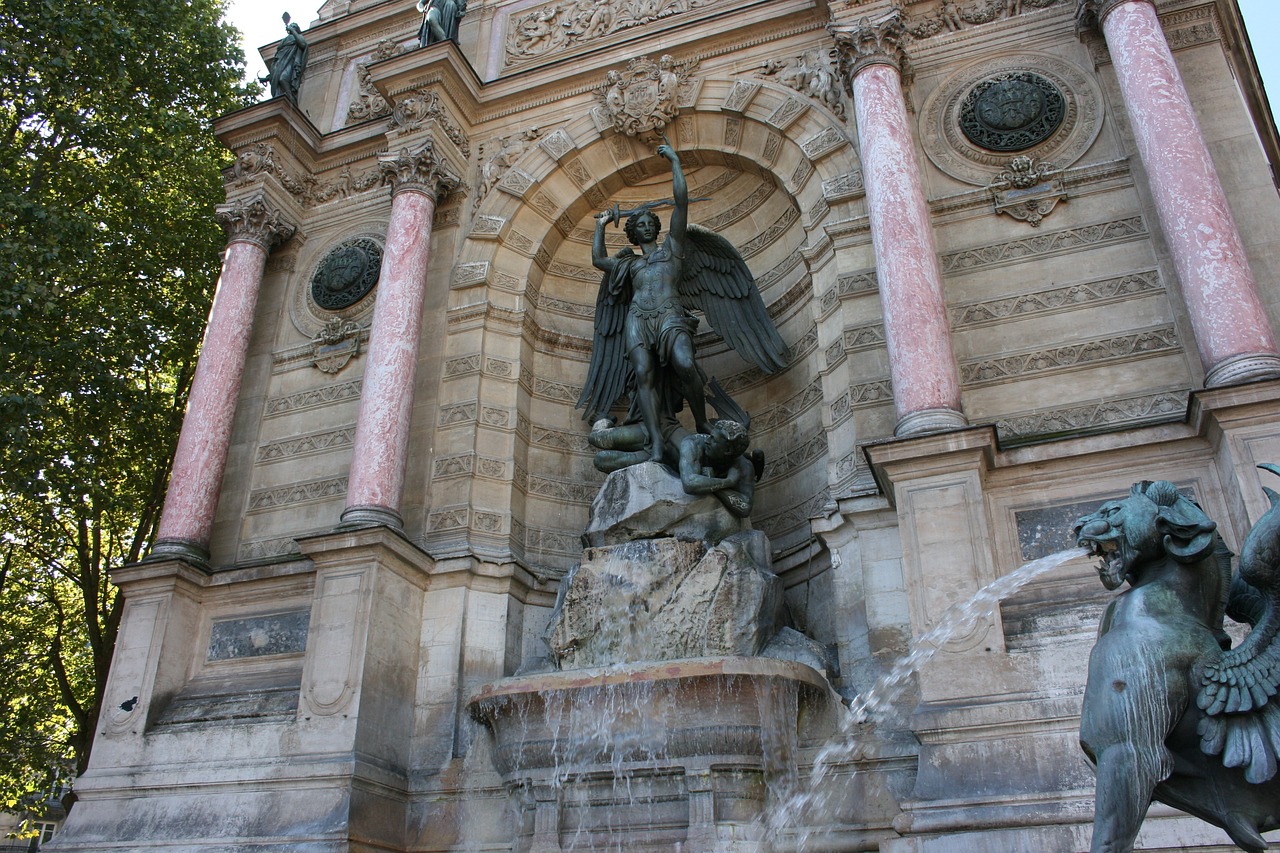
    - Place Saint-Michel, where the fountain’s winged Archangel Michael (sword raised) symbolizes good vs. evil. Locals gather here to celebrate victories, like the 1998 World Cup, when someone dressed the angel in Zidane’s jersey!

    Pro tip: Notice the fountain’s backdrop mimics a triumphal arch? When Boulevard Saint-Michel was built, architects transformed a truncated 6-story building into this symbolic masterpiece.

    20th-Century Touches

    The two chimeras flanking the fountain honor French Resistance fighters and WWII soldiers.


Shakespeare & Co.
  • Shakespeare & Co.

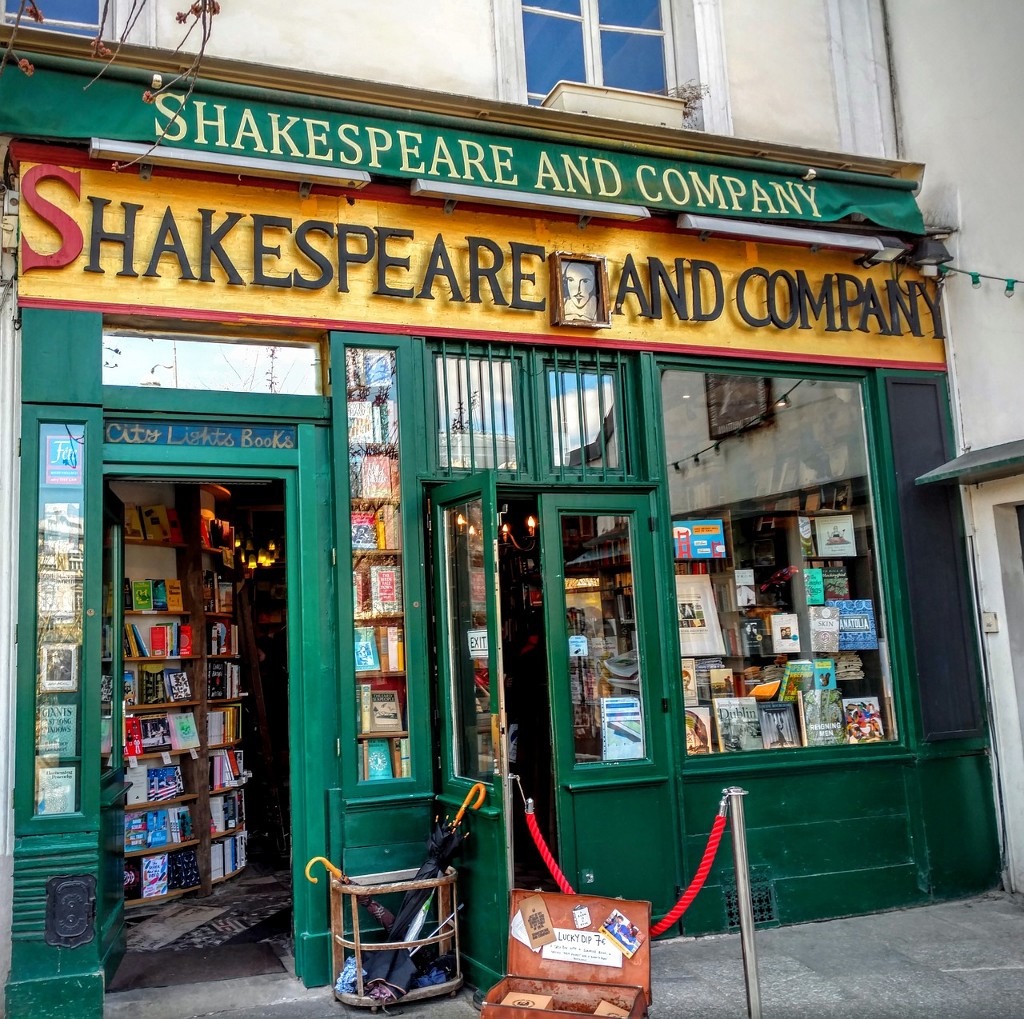
  • We're standing in Shakespeare and Company, one of the most enigmatic and iconic bookstores in Paris. In fact, it was the first English-language bookstore in the city. And today I'm here to tell you its fascinating history.The first Shakespeare and Co...

    We're standing in Shakespeare and Company, one of the most enigmatic and iconic bookstores in Paris. In fact, it was the first English-language bookstore in the city. And today I'm here to tell you its fascinating history.

    The first Shakespeare and Company was founded in 1919 by an American woman named Sylvia Beach, originally from Pennsylvania. Sylvia came to live in Paris, and while looking for a bookstore to buy English books, she realized none existed. So, without hesitation, she decided to open the first English-language bookstore in Paris.

    (It should be noted that this bookstore wasn't located in this spot where we are now, but in another nearby location, which we'll pass by later and I'll point out to you. Here, in this place, there was another bookstore called Le Mistral. But we'll get to that. First, let's talk about the original Shakespeare and Company.)

    From the beginning, Sylvia faced a major obstacle: many books were censored in countries like the United States or England. One of them was Ulysses by James Joyce. When Sylvia tried to get copies of this novel, publishers flatly refused.

    And what did she do? Well, she decided to turn her bookstore into a publishing house as well and began publishing precisely those books banned in other countries. This attracted a large community of readers, Americans and English, who came to Paris to read what they couldn't find in their own countries. Thus, the bookstore gained an enormous reputation.

    Among its most famous visitors was Ernest Hemingway, known for the precision and clarity of his descriptions. By the way, Hemingway didn't stay just anywhere when he came to Paris. He stayed in the most luxurious hotel in the city. Do you know which one it was?
    Exactly! The Hôtel Ritz, which became a symbol of luxury starting in 1871, as the first hotel to offer private bathrooms in the rooms. Something that seems normal to us today but was a true privilege back then. It also offered electric lighting and telephones in every suite, a real innovation for the time.

    The Nazi Occupation & Closure

    The heyday of the original Shakespeare and Company came in the 1930s, but in 1941 it had to close. The reason? The Nazi occupation. Some say Sylvia Beach couldn't stand her new clientele: German soldiers with knee-high boots. Others claim it was the Nazis themselves who shut down the bookstore, suspecting that anti-regime ideas could emerge there.

    Either way, the closure was permanent. Sylvia was even imprisoned, but thanks to pressure from close contacts in the United States, she was eventually released. After leaving prison, she returned to her country and never came back to Paris.

    Now then... why does a Shakespeare and Company exist in this location today?

    As I mentioned earlier, this was the site of Le Mistral bookstore, founded in 1951 by George Whitman, also an American. This place had an even more peculiar history, as it was built on the remains of an old monastery. Whitman considered himself "the guardian of knowledge," and his bookstore didn't just sell books: it also hosted travelers with no money, known as tumbleweeds, a reference to those rolling plants we see in Western movies, blown by the wind from place to place.

    These tumbleweeds, among them even famous actors like Ethan Hawke and authors like J.K. Rowling, who was inspired by this shop to later describe the magical bookstore in Harry Potter, would sometimes stay for several days. But there were three very clear conditions for staying:

    1. Write a short autobiography on a sheet of paper.
    2. Read a book a day.
    3. Help with some tasks in the bookstore.

    The bookstore has two floors, and it's upstairs where several couches are located for these pilgrims to sleep. At night, by candlelight, they shared the stories they had read during the day. From these conversations, new ideas, projects... and even novels were born.

    A curiosity of this bookstore is that inside there's a wishing well, and occasionally one of the employees dresses up as a pirate, stands on a barrel, and recites passages from works, usually Shakespeare, in English aloud. It's a scene that seems straight out of the Middle Ages, like a modern troubadour in the heart of Paris.

    Actually, the bookstore is divided into three parts:

    The first shop, the main one, usually has a line to enter and is where you'll find current books, similar to any English bookstore.
    The second shop, quieter, houses antique books and first editions. There, prices don't go below 800 to 1,200 euros.
    And the third part is a small café where customers don't just come to have coffee, but also to chat, in English, of course, with the waiters about literature, novels, or authors.


Saint Julien-le-Pauvre Church
  • Saint Julien-le-Pauvre Church

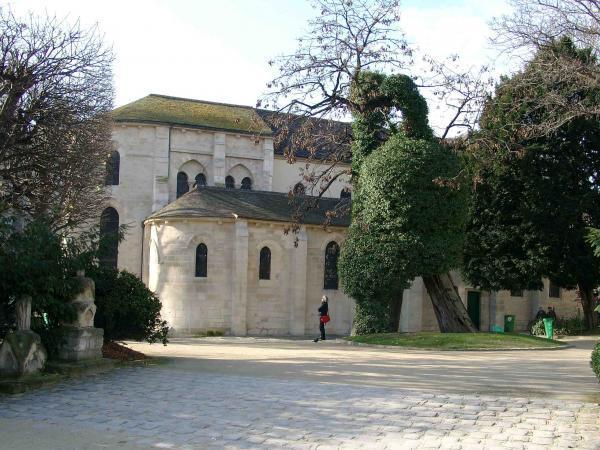
  • We find ourselves in the enigmatic René Viviani Park, a small but symbolic corner of Paris. This park is named after René Viviani, a French lawyer and politician much loved by his family... though less so by others, as he was the creator of the incom...

    We find ourselves in the enigmatic René Viviani Park, a small but symbolic corner of Paris. This park is named after René Viviani, a French lawyer and politician much loved by his family... though less so by others, as he was the creator of the income tax.

    In this park, we can find several interesting relics. Right where this sculpture representing the Tree of Life stands today, there once was a fountain. This fountain commemorated the convergence of two Roman roads here: one running north-south to Orléans, and another east-west to Lyon. As you can see, this was an important crossroads in Roman times.

    In 1982, this modern sculpture replaced the old fountain. As I mentioned, it symbolizes the Tree of Life. We can see several children helping each other climb the tree: some embrace, others push upwards, but only a few reach the top. This work pays tribute to the over 11,000 Jewish children deported from France to Nazi concentration camps between 1942 and 1944.

    If you look towards the back of the park, you'll see another sculpture, this one made of glass, depicting two children's hands trying to touch. And in the middle of the tree trunk, we can spot two deer heads. These figures relate to a medieval fable I'll tell you shortly, which is intimately connected to the church we'll visit next.

    The Church of Saint-Julien-le-Pauvre

    Right next to the park stands Paris's oldest church, built in 693 AD (7th century). However, in the 9th century, Paris was besieged by Vikings who entered via the river in their longships and, using catapults, destroyed much of the city including this church.

    It was rebuilt in 1160 when the Longpont Priory was established here. Originally, this church was called Saint Julien l'Hospitalier ("Julian the Hospitaller") because - according to tradition - this saint offered free lodging to penniless travelers and pilgrims. Doesn't that remind you of what George Whitman did at Shakespeare and Company?

    From 1593, the church was used by the University of Paris for teaching, and in 1601 it became a place of worship for Greek Melkite Catholics, a branch of the Orthodox Church. Unlike the Roman Catholic Church which answers to the Pope, Orthodox churches are governed by different patriarchates across Asia and Eastern Europe.

    The Deer Fable and the Origin of "Saint-Julien-le-Pauvre"

    Now let's return to the deer heads in the park sculpture, as they're directly connected to the story of Saint Julian the Poor (le Pauvre). He wasn't called "poor" due to lack of money, but because of the tragic story I'm about to tell.

    Many centuries ago, a boy named Julian lived happily with his parents in a distant kingdom. Like all children, he loved playing in the forest. One day, while playing among the trees, a white deer appeared - not only staring at him but speaking! It said:
    "Julian, one day you will kill your parents."

    The boy was completely traumatized, not just by the terrifying prophecy but by the fact that a deer spoke to him - enough to traumatize any child.

    As a teenager, Julian decided to leave and move to another kingdom, fearing the deer's prophecy might come true. Over time he married, bought a house and started a new life. Years later, his parents - having heard nothing from him - went searching. After weeks of travel, they found his house. His wife welcomed them warmly and offered them the marital bed to rest.

    But Julian returned that same night. Entering and not seeing his wife, he assumed she was already asleep upstairs. Going to the bedroom and seeing two strangers in his bed, he believed they'd harmed his wife. In a fit of rage, he took a sword and killed them.

    Only at dawn did he discover the terrible truth: he had murdered his own parents... thus fulfilling the deer's prophecy.

    From then on, consumed by remorse, Julian dedicated his life to prayer and helping the needy, seeking redemption. That's why he was called "the Poor" - not for material poverty, but for the spiritual burden he carried until his dying day.

    A Tree With History

    To conclude, look at this tree here. It's a locust tree, and none other than Paris's oldest tree. For over 400 springs it has bloomed, and though showing signs of age, it still stands thanks to a steel crutch supporting it. This crutch is beam-shaped, covered to resemble wood (though artificial), helping it bear the weight of years.

    Let's hope that, like Julian's story, this tree continues standing for many more years.


Saint-Severin Church
  • Saint-Severin Church

  • We are standing in front of the Church of Saint-Séverin, a jewel of Parisian Gothic architecture. But before we talk about it, look down at the ground: on the sidewalk, you’ll see small golden shell-shaped designs. These shells symbolize the Way of S...

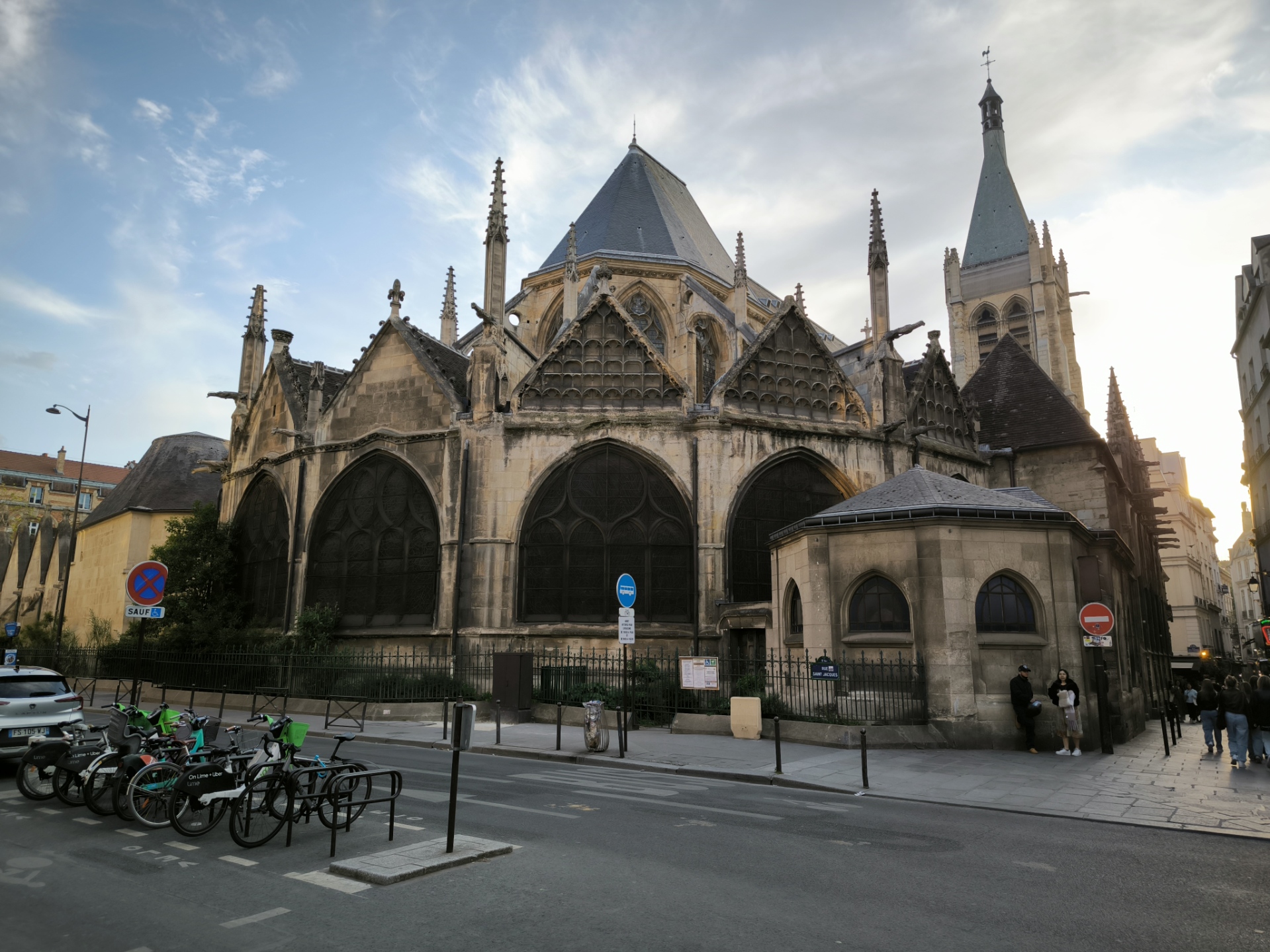
    We are standing in front of the Church of Saint-Séverin, a jewel of Parisian Gothic architecture. But before we talk about it, look down at the ground: on the sidewalk, you’ll see small golden shell-shaped designs. These shells symbolize the Way of St. James (Camino de Santiago). If you notice, the name of this street is rue Saint-Jacques, do you know what "Saint-Jacques" means? In Portuguese, it’s “São Tiago,” or Santiago. So we’re standing on one of the historic routes of the Camino de Santiago, that ancient Christian pilgrimage connecting various points of Europe to the Galician city.

    Now, back to the church: Saint-Séverin is a magnificent example of Gothic style, built by order of King Philip Augustus in the 12th century. This was the same king who fully walled Paris and who, alongside England’s Richard the Lionheart, set off for the Crusades to reclaim Jerusalem, then known as the Holy Land.

    The church took 250 years to complete, a testament to its scale. Like Notre-Dame, it’s Gothic, but details reveal its greater antiquity. For instance, Saint-Séverin’s gargoyles are far more weathered. And that’s no accident: Notre-Dame’s were rebuilt in the 19th century (specifically in 1886) by architect Viollet-le-Duc after damage during the French Revolution.

    Saint-Séverin is renowned for its stunning stained glass. Some windows, especially at the rear, use opaque glass. Why? To capture exterior light and diffuse it inside, creating that ethereal, purifying glow typical of Gothic art. The oldest windows, dating to the 15th and 16th centuries, line the central nave, which soars 17 meters high, depicting biblical scenes and French monarchs.

    Inside, you’ll also find side chapels, each dedicated to a different saint: Saint Genevieve, Saint Anne, Saint Anthony of Padua… each with its own stained-glass narrative of the saint’s life.

    Near the entrance, you’ll see more modern stained glass from the 1970s, replacing originals destroyed by a shell impact during World War II. Their contemporary style, designed by artist Jean Bazine, stands in stark contrast.

    One of the quirkiest features is a spiral, Solomonic column acting as the church’s central pillar. You’ll also spot a grand organ and upper galleries where pilgrims once rested.

    This is why, in the 13th century, the botafumeiro (a giant hanging censer) became popular, its smoke masked the strong odors of pilgrims who’d gone weeks without washing.

    The Façade and Its Symbolism

    As you exit through the main door, glance at the western façade. The central window depicts the flames of Hell, and if you study the gargoyles closely, some have grotesque faces, like a pig (symbolizing gluttony) or figures representing wrath, envy, or even celibacy (e.g., a nun shedding her habit atop the bell tower).

    That bell tower holds a historical gem: Paris’s oldest bell, Macée, cast in 1412. It still rings today.

    A Brief History of Gothic Architecture

    Since we’re discussing Gothic art, let’s understand its origins. This style emerged in France after the year 1000, alongside a shift in religious mentality.

    Before 1000, the dominant belief was that God was a severe punisher, capable of unleashing plagues, famine, and war. Many even feared the Apocalypse would arrive in the year 1000. Sound familiar? We’ve had our own “end of the world” with the 2012 Mayan calendar… yet here we are.

    But no apocalypse came in 1000. Instead, progress did: Viking raids on Paris ceased, science advanced, and some afflictions were overcome. People began to see God as merciful rather than cruel.

    This shift was reflected in art. Gothic churches soared skyward, flooded with light, meant to lift people toward God, both physically and spiritually.

    Now, let’s move on. We’re leaving the 5th arrondissement for the 6th, heading down rue Saint-André-des-Arts to the street where a certain Spanish artist once lived… but I’ll tell you more about that soon.


Validar Cookies

Este sitio web recopila cookies para ofrecer una mejor experiencia de usuario y permitirle inscribirse en nuestro programa de bienestar en línea, fácilmente, en solo unos pocos pasos. No vendemos ni cedemos sus datos por ningún motivo. Saber mas...